How to Find Someone's Middle Name: Practical and Legal Ways
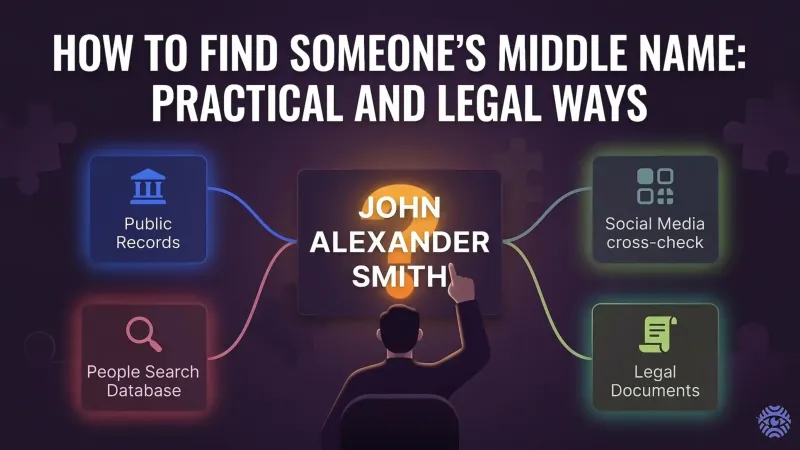
There are legitimate reasons why most folks need to find someone's middle name. Background checks, genealogy searches, checking identity, or reconnecting with old acquaintances.
But middle names don't appear everywhere. They're optional on most forms, buried in privacy controls, and often reduced to an initial.
To perform a middle name lookup legally and ethically, use public records and other open sources.
Finding Middle Names in Public and Legal Records
Public records remain the most reliable source for full legal names. Government documents require complete names, making them ideal for middle name search efforts.
Names on a birth certificate are the full names at the time of registration. Access rules vary by state. Some may be requested by anyone, others only by family members.
Full names are used on marriage licenses and divorce decrees, of course. These records are usually kept by the county clerk's office, and many are available online. Both the original names and the new ones are in these documents.
Property records require legal names. If you own property, chances are your full name is on file with the county assessor and recorder's office.
Middle names are frequently included in court documents, particularly in civil cases and probate actions. Federal court records can be found via PACER, and state records are available on county clerk websites.
Using Social Media and Online Profiles to Surface Middle Names
Middle names are sometimes advertised on social media profiles, but what you share is up to you.
Facebook allows middle names to be used in profiles. Check the "About" section. Even if it's private, the name field is typically still visible.
On LinkedIn people put middle initials or full middle names, especially when using complete legal names for business. Full names as they appear in publications can be found on faculty profiles on ResearchGate/Google Scholar.
Instagram and Twitter rarely show middle names directly. But check the bio sections and the linked websites where people sometimes mention their full name.
A reverse username search can uncover additional profiles in which the person might have listed their full name. What's hidden on one platform might be public on another.
People Search Databases and X-ray.Contact as a Data Source
People search databases aggregate information from multiple sources into searchable profiles. These compile public records, social media data, and other available information.
X-ray.Contact specializes in finding hidden profiles on social networks and connecting scattered online information. The platform searches across multiple data points to surface complete names people use across different online spaces.
These databases work best when you know the person's first and last name and a general location. More identifying information means more accurate results.
Data aggregators sometimes contain outdated or incorrect information. Always verify findings through multiple sources before relying on them.
Government and Regulatory Records That Contain Full Names
Several government databases contain full legal names for specific purposes.
Voter registration records are public in most states. These include full legal names as they appear on government IDs. Access methods vary by state.
Professional licensing boards maintain databases of licensed professionals. Doctors, lawyers, nurses, real estate agents, and contractors require licenses that list their complete legal names. Most state boards offer online search functions.
Business registration records show the full names of business owners and corporate officers. Secretary of State offices maintain searchable databases.
Federal Aviation Administration records list names of licensed pilots with middle names or initials for most entries.
Family, Associated Records, and Indirect Mentions
Sometimes you find someone's middle name by looking at people connected to them.
Obituaries and death notices often list survivors with full names. If researching someone's relatives, obituaries might mention the person's complete name.
Wedding announcements in newspapers typically include the full names of the couple and sometimes their parents. Local newspaper archives often have searchable databases.
School yearbooks, graduation programs, and alumni directories sometimes use full names. Many schools have digitized yearbooks available through Classmates.com or Ancestry.com.
Family tree websites like Ancestry.com and FamilySearch.org contain records submitted by genealogy researchers. People often include middle names in family trees.
Church records, baptism certificates, and lists from religious organizations often include full legal names. These might require direct contact with the organization.
How to Verify a Middle Name Before Using It
Finding a name isn't enough. Confirm it's correct before using it officially.
Cross-reference multiple sources. If the same middle name appears in three or four different records, it's probably accurate. One mention could be a typo.
Check the date of the information. People sometimes legally change names. A record from 20 years ago might not reflect current legal names.
Look for government-issued document references. Information from birth certificates, driver's licenses, or passports is more reliable than user-submitted data.
Consider asking directly if possible. A reverse name look up might give you enough information to reach out. Many people will share their middle name if you explain why you need it.
Why Some Middle Names Cannot Be Found
Some people don't even HAVE a middle name. Many cultures don't use them. There are parents who just don't provide middle names for their children.
Privacy laws protect certain records. Some states close birth records altogether. Adoption records are generally confidential.
Individuals who successfully change their names can occasionally conceal those changes. Court filings can be sealed when there are concerns about a person's safety.
Immigrants have changed their names upon arrival in new countries. They may have different names in official records in their home country. Transliteration between alphabets creates variations.
Errors in record-keeping happen. Names are misspelled, truncated, or entered incorrectly. Absent middle names could be buried in typos.
Digital footprints vary by age. Older people use social media less. Younger people may be keeping information online purposely because of privacy concerns.
Final Thoughts on Middle Name Research
Obtaining a person's middle name would require determination and several tactics. Begin with free public records and social media. If necessary, move on to paid people search databases. Always verify through multiple sources.
When searching for middle names, a legitimate need must be met. Stalking, harassment, identity theft, and fraud are illegal regardless of how you obtained the information.
The rest find what they need through online databases, public records, and social media profiles. These things work in the vast majority of cases where someone has a middle name and hasn't gone to extraordinary lengths to conceal it.