How Long Does a Background Check Take?
If you are going to apply for a new job, you may need to undergo a background check. Today, this is most companies’ standard procedure.
A background check is when an employer investigates the history of your past to see if you’ve spoken truth in your resume and application. It also verifies you’re an acceptable and safe choice for this job. However, there is always one big question: how long it takes to conduct a background check. The fact is that the timing of background checks depends on a number of factors as well as one general rule: more complex and time-consuming information requires longer periods with which to confirm.
Whether you’re in the job market for the first time or want a move upwards, this guide will explain average time for background check, why it often may take so long, and what this means to your job application.
How Long Do Background Checks Take?
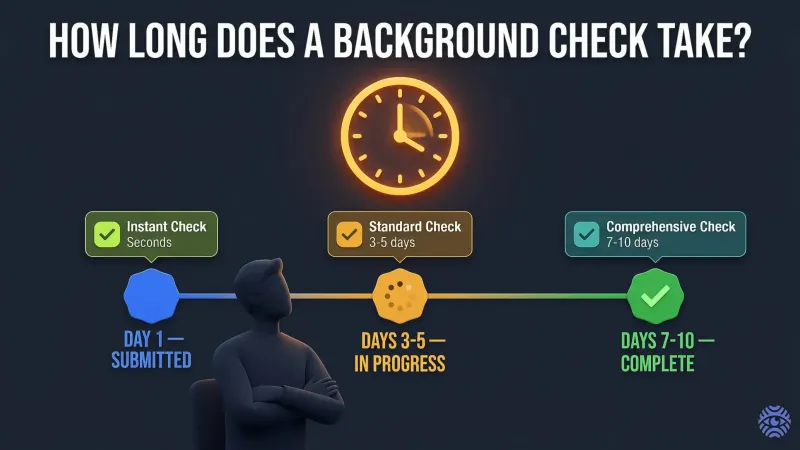
The simple answer: most background checks take 1 to 5 business days. But this is only an average.
Some fast background checks such as ID verification, can be done instantly with online databases. On the other hand, checks that involve schools, past jobs, or state records may take much longer. If you lived in many places or worked in several companies, it usually adds more time.
Here are a few things that affect background check time:
- Type of check (criminal, education, work, driving, etc.)
- How many checks are required
- How fast schools, past employers, or state offices reply
- Whether information is stored online or in paper files
Employers often use more than one type of check. To see all the common options, read about the types of background checks.
Common Types of Background Checks and Their Timing
Below are the main checks and how long they usually take.
Social Background Check
A social background check looks at your online activity. Employers may check Facebook, Instagram, Twitter, or LinkedIn to see how you present yourself. They are mostly looking for warning signs like hateful speech, offensive posts, or unprofessional behavior.
Since this is mostly online, it is one of the quickest checks. A company can finish in a few hours or up to 2 days. Some businesses also use social media checks tools to speed things up.
Employment Background Check
This check looks at your work history. Employers confirm where you worked, your job title, and the dates. Sometimes they also ask about performance or reason for leaving.
The average background check time here is 1 to 3 business days, but it can take longer if old companies no longer exist or are slow to answer.
Criminal Background Check
A criminal background check shows if you have a record. A local check may take just 1 to 2 days, but if the company checks across states or countries, it can take up to a week or more. Some states only keep records in local courts, which means someone has to look them up by hand.
MVR Check (Motor Vehicle Record)
An MVR check looks at your driving record. This is common for delivery, truck driving, or rideshare jobs.
Most of the time, this check takes 1 to 3 days. But if you have lived in several states, each record has to be checked separately.
Employment Verification
This step is when the hiring company contacts your past employers. They confirm things like your job role, salary, and dates. It can take 2 to 5 days because companies often reply slowly or only at certain times.
Education Verification
An education verification checks your school or university records. Many schools answer quickly, but older records may take longer to find. The usual time is 2 to 4 days, but some take a week.
State Background Check
This check uses state databases for records. Some states have modern systems that are fast. Others still use manual searches that may take weeks. Because of this, the timing ranges from 3 days to several weeks.
Why Is My Background Check Taking So Long?
If your background check is not done in a few days, don’t panic. There are many simple reasons why it might take longer:
- A past job or school is slow to reply
- The employer ordered many checks at once
- Court or government offices still use paper records
- You lived in more than one state or country
- Your name is very common, which makes matching records harder
Even when everything is correct, the background check can be slow because of paperwork or waiting for replies.
Is It a Bad Sign If Your Background Check Takes a Long Time?
Not usually. Many people worry when the background check process takes longer than expected. But most delays have nothing to do with problems in your history.
For example:
- A past employer might only answer calls once a week
- A university might take days to confirm old diplomas
- A court office may need to search physical records
So a long wait does not mean you failed. In fact, most people who wait still pass their checks once all the information comes back.
Final Thoughts
So, how long, on average, does a background check typically take?
The average time for background checks, broken down into steps, is 1 to 5 business days. But some background checks take longer. Quick one-off checks, such as an ID card examination, review of driving records, or a plunge into someone’s social media habits, can often be wrapped up this quickly. More complex reviews, such as state or criminal ones, may take a week or longer.
When your background check is delayed, do not automatically assume the worst. Usually, that simply means the employer is still waiting for information from schools, past employers, or state offices.